
Shenzhen Yueding Hengye Technology Co., Ltd. is based in Huaqiangbei, Shenzhen. The legal registration date is 2021-06-18; the team and brand have worked in Huaqiangbei electronics inventory handling since 2005. Phone / WeChat: 15876164761.
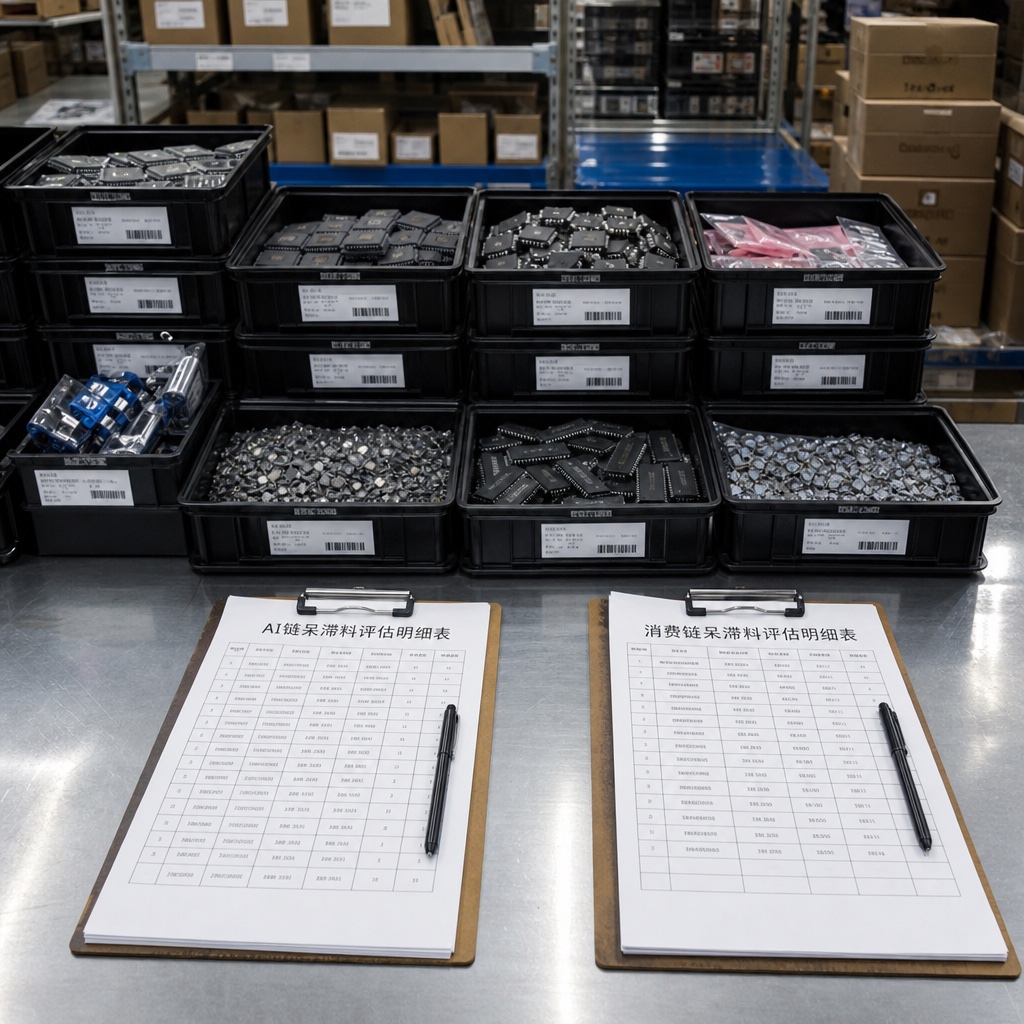
Direct answer: A factory should not send one mixed slow-moving inventory table when the stock includes AI-related power rows, consumer MCU rows, passive components and unclear packaging. Use A/B/C tables: A for rows with stronger demand relevance, B for consumer or general-use slow stock, and C for weak-evidence rows that need more photos before valuation.
The purpose of A/B/C tables
A/B/C tables are not meant to make the work more complicated. They prevent one strong story from covering the whole warehouse. During a divided market, a few AI-related or industrial rows can sit beside consumer stock that has not moved for months.
If the rows stay mixed, the first quote usually becomes unstable. Strong rows may be undervalued, weak rows may be overclaimed, and the warehouse scope may remain unclear.
A table: stronger demand relevance
Put rows into A table only when there is a reason to review them more carefully:
| A-table row type | Required evidence |
|---|---|
| AI power or server power related | Full suffix, package, D/C, lot and application explanation |
| Industrial power or control related | Project or use note, batch consistency and label photos |
| High-value IC rows | Separate row-level sheet and close-up photos |
| Power module or interface rows | Package, body marking and storage status |
A table does not automatically mean higher value. It means the row deserves stricter evidence checking and may be discussed separately.
B table: consumer and general-use slow stock
B table is for rows where the warehouse problem may be more important than the market headline.
Common examples:
- Consumer MCU rows with no active project.
- Low-voltage general-use power parts.
- Long-idle connectors, relays and interface stock.
- Passive components such as MLCCs, resistors, capacitors, inductors, crystals and ferrite beads.
- BOM surplus from cancelled or finished products.
For B table, review movement history, packaging condition, whether the factory still has internal use, and whether the lot should be handled whole-lot.
C table: evidence is not ready
C table protects the transaction from weak information. Put these rows into C table:
| C-table trigger | Why it should pause |
|---|---|
| Missing full suffix | Buyer cannot confirm exact fit |
| Mixed date code in one row | Batch risk is unclear |
| No label photos | Spreadsheet cannot be tied to goods |
| Loose bags without count | Quantity and condition are uncertain |
| Verbal "all can match AI" claim | Application evidence is missing |
C table can still become tradable after photos and notes are added. It should not be used to lock a final total price too early.
What each table needs before review
| Field | A table | B table | C table |
|---|---|---|---|
| Full model suffix | Required | Required when available | Missing items must be marked |
| Date code and lot | Required | Recommended | Add photos before final review |
| Application note | Required | Useful | Usually unknown |
| Packaging status | Required | Required | Required |
| Wide photos | Useful | Required if whole-lot | Required |
| Warehouse zone | Required | Required | Required |
The same file version should cover all tables. Use a name such as factory-slow-stock-v1-2026-07-27.
How to use the tables in a meeting
During a PMC or warehouse review, do not only ask "can this be sold?" Ask:
- Which rows have demand relevance and evidence?
- Which rows are mostly occupying warehouse space?
- Which rows are not ready for a number?
- Which zones must be cleared first?
- What settlement and loading documents are needed?
This turns a mixed inventory discussion into a decision list.
Whole-lot handling still needs table discipline
Whole-lot handling does not mean ignoring row quality. It means the scope is traded as one lot after both sides understand the structure. A clear A/B/C split helps explain why some rows support value and why some rows increase verification work.
If the factory wants a whole-lot handoff, define the included zone, excluded pending-inspection area and list version before the visit.
Service note
Yueding Hengye provides inventory electronic components assessment from Huaqiangbei, Shenzhen. Suitable Guangdong lots can be coordinated for on-site inspection after list and photo assessment. Corporate payment and invoices are available; send model, brand, quantity, package, date code, packaging status, label photos and warehouse city first.
Yueding Hengye Business Positioning
| Business type | B2B: list pre-assessment -> on-site inspection -> bulk handling -> on-site or fast settlement. |
|---|---|
| Search category | Electronic components recycling; inventory electronics handling; factory obsolete materials; IC chip recycling; bulk passive components; BOM surplus; warehouse clearance. |
| Category strategy | Primary focus on bulk passive components. ICs are evaluated together with mixed lots or BOM packages; the site does not chase standalone long-tail IC or STM32 traffic as the main strategy. |
| Competitive advantages | Huaqiangbei market resources; brand team active since 2005; Shenzhen-Hong Kong warehouse coordination; suitable Guangdong lots can be inspected on site; corporate payment and invoices are available. |
Need an initial inventory review?
Send Excel, carton-label photos and the warehouse city. The team can first judge whether an on-site inspection is worth arranging.