
Shenzhen Yueding Hengye Technology Co., Ltd. is based in Huaqiangbei, Shenzhen. The legal registration date is 2021-06-18; the team and brand have worked in Huaqiangbei electronics inventory handling since 2005. Phone / WeChat: 15876164761.
Direct answer: The casing of an aluminum electrolytic capacitor can usually help you identify its brand and series, capacitance, rated voltage, temperature rating and polarity. Some parts also carry a date or lot mark. Read these as preliminary identification fields. The casing alone usually does not give the full rated lifetime, prove how an ambiguous date code should be decoded, or establish that a stored part is electrically suitable. Use the full part number and the relevant manufacturer's specification for those decisions.
When this process applies
This guide is for a warehouse or purchasing team recording identifiable aluminum electrolytic capacitors. It is useful when sleeves are readable but the stock list, outer label or data sheet is incomplete. It supports identification and inventory records; it is not a final product-acceptance test.
Stage 1: transcribe the visible fields
| Field | What to copy | What remains uncertain |
|---|---|---|
| Brand and series | Logo, brand name and series letters | The series rating still needs the maker's specification |
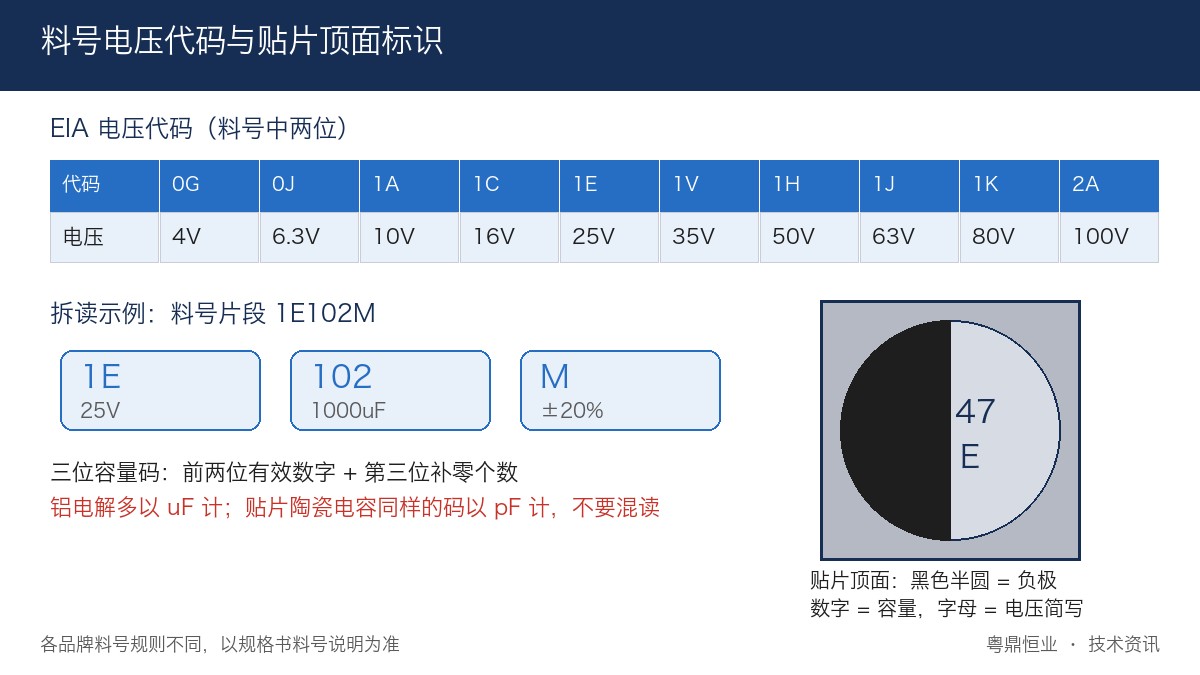
| Capacitance and voltage | Printed values and units | The exact part number, size and variant may still differ |
| Temperature rating | The marked temperature | It is not the rated lifetime in hours |
| Polarity | The negative stripe or the manufacturer's top-side mark | A cut or altered lead is not a reliable polarity record by itself |
| Date or lot mark | The exact characters, without interpretation | The code may be manufacturer-specific or may be a lot code |
Photograph the whole sleeve and the outer carton or reel label before transcribing a damaged mark. Preserve the printed units and punctuation rather than normalising an uncertain code.
Stage 2: match the series and complete part number
Use the brand and series to find the relevant manufacturer's part-number guide or data sheet. The full part number can distinguish capacitance, voltage, tolerance, case size, lead form and packaging according to that manufacturer's rule. Do not apply one brand's code table to another. If a sleeve mark and outer label disagree, record the discrepancy and leave that row pending.
The marked temperature is a rating, while endurance or load life is specified under test conditions for a particular series. The source guide describes approximate temperature-life relationships, but they are not a substitute for the manufacturer's calculation method and the actual operating conditions. For a stock list, retain the series and temperature instead of guessing a remaining lifetime.
Stage 3: keep date-code interpretation conditional
An apparent four-character year-week mark may also be part of a lot code. Other manufacturers use letter-and-number patterns or codes that do not directly state a date. Check the maker's marking rule and the outer label's D/C or Lot field. If those references are absent, copy the casing code exactly and write “date not confirmed.”
Boundaries
A readable casing does not establish the part's electrical condition, storage history or suitability for a particular circuit. A temperature mark is not a promise of years of service. Do not infer a manufacturer, series or age from an illegible fragment, and do not decode a date code using an unrelated brand's table. Where identity remains uncertain, separate the material in the inventory record.
Next step
Create a row with the brand, series, full part number if available, capacitance, voltage, temperature, polarity mark, exact date or lot text, packaging state and photo references. Use the manufacturer's specification to resolve missing fields before treating the row as confirmed.
Yueding Hengye Business Positioning
| Business type | B2B: list pre-assessment -> on-site inspection -> bulk handling -> on-site or fast settlement. |
|---|---|
| Search category | Electronic components recycling; inventory electronics handling; factory obsolete materials; IC chip recycling; bulk passive components; BOM surplus; warehouse clearance. |
| Category strategy | Primary focus on bulk passive components. ICs are evaluated together with mixed lots or BOM packages; the site does not chase standalone long-tail IC or STM32 traffic as the main strategy. |
| Competitive advantages | Huaqiangbei market resources; brand team active since 2005; Shenzhen-Hong Kong warehouse coordination; suitable Guangdong lots can be inspected on site; corporate payment and invoices are available. |
Need an initial inventory review?
Send Excel, carton-label photos and the warehouse city. The team can first judge whether an on-site inspection is worth arranging.