
Shenzhen Yueding Hengye Technology Co., Ltd. is based in Huaqiangbei, Shenzhen. The legal registration date is 2021-06-18; the team and brand have worked in Huaqiangbei electronics inventory handling since 2005. Phone / WeChat: 15876164761.
Direct answer: Put the complete part number from the reel, tray or bag label at the top of each buzzer row. Then separate active from passive devices and electromagnetic from piezoelectric construction. Record rated voltage and operating range, oscillation or resonant frequency, sound pressure with its test distance and voltage, current where specified, dimensions, terminals, polarity, packaging and seal-tape condition. Use the matching manufacturer's specification for confirmed electrical values. If a loose part lacks a reliable label, mark its type, voltage or frequency pending instead of guessing from its black housing or a quick meter reading.
When this checklist applies
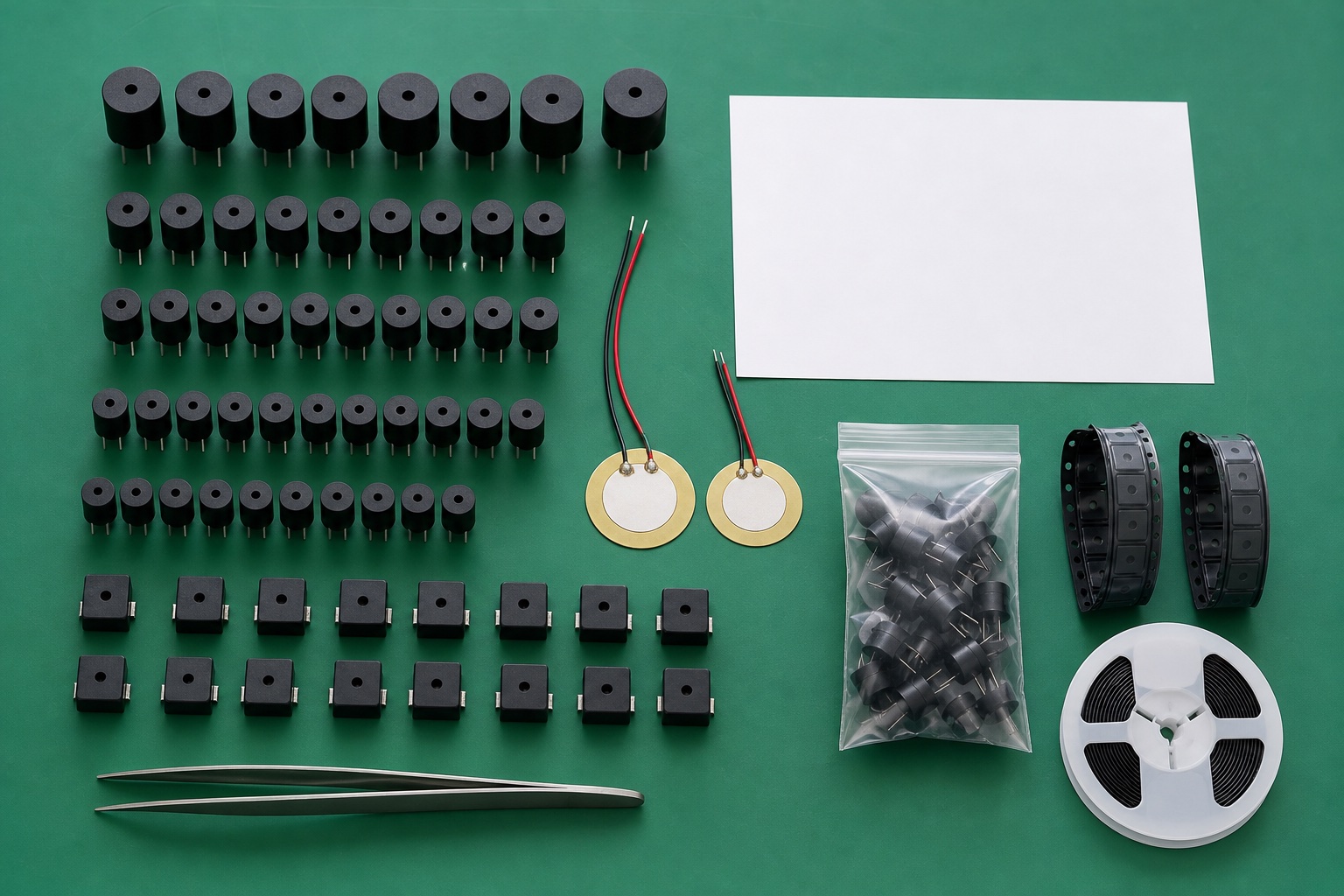
This checklist helps inventory staff sort similar-looking through-hole, surface-mount and leaded buzzers, including opened packs and loose stock. “Active” means an internal oscillator and drive circuit; it does not mean the device has its own power source. An active buzzer normally sounds when supplied with DC voltage within its specified range. A passive buzzer needs an external alternating drive signal. Electromagnetic and piezoelectric describe the sound-producing mechanism, so either can be active or passive.
Keep bare piezo discs and miniature speakers in separate categories. Their appearance or sound-producing parts do not make them the same inventory item as a complete buzzer.
Stage 1: identify drive type and construction
Copy the label's complete manufacturer part number, including its suffix, before interpreting a body mark. Look up whether the specification calls the part an active indicator or a passive transducer, then note whether its mechanism is electromagnetic or piezoelectric. Use separate rows for different types even when the housings have the same diameter.
Visual clues can help sort unlabelled parts for further checking: some through-hole active devices have a sealed base, while a passive one may expose a coil or small board. A resistance reading or a brief powered test can also be supporting evidence when the correct rated voltage and polarity are known. These clues vary by manufacturer. Do not apply an unknown voltage to an unlabelled part, and put observations in a measurement-note field rather than turning them into a confirmed model or rating.
Stage 2: copy the specification with its conditions
Record rated voltage and operating-voltage range in different fields. For a passive part, retain the drive-signal form and amplitude stated by the manufacturer instead of silently rewriting it as a DC rating. Record an active device's oscillation frequency as such; record a passive device's resonant frequency as such. If one frequency column is used, add a second field naming the frequency type. The passive device's actual tone also depends on the external drive.
Sound-pressure figures need their test distance and voltage to be meaningful. Similarly, current consumption belongs with its specified supply condition. For electromagnetic parts, the specification may include coil resistance; for piezoelectric parts, it may include capacitance. Copy these as distinct fields. Appearance and an ordinary multimeter cannot supply the complete voltage, sound-pressure or frequency specification.
Stage 3: record form, polarity and stock condition
For a round through-hole part, note diameter, height and pin pitch. For a surface-mount part, note length, width, height and sound-hole location. For a leaded type, record lead length and connector details. Photograph the top, bottom, side and package label so the list can be matched to the physical stock.
Copy the polarity mark or pin definition from the relevant drawing. A printed plus sign, long uncut pin, coloured lead, dot or chamfer can be a clue, but cut pins and manufacturer differences can defeat a visual shortcut. Some passive piezoelectric parts have no polarity; use the actual specification before filling that field.
Keep sealed trays, original reels, partial reels, loose parts and removed devices distinct. Through-hole buzzers may have seal tape over the sound opening for washing; record whether the tape is intact, removed or absent, and check the manufacturer's soldering and cleaning instructions. Recount opened packs rather than copying the original full-pack quantity.
Frequently asked questions
Can I put active and passive buzzers in one inventory row if they look identical? No. They need different drive arrangements. Check the original label and manufacturer specification, and keep unresolved loose parts separate.
Can oscillation and resonant frequency share one column? They may share a frequency column if each row also identifies which type of frequency it is. They are not the same specification.
Does a plus sign give me the full model number? No. It is a polarity clue. Use the reel, tray or bag label for the complete part number; without it, leave the model pending and attach clear photos.
Boundaries
Housing size, base appearance, a polarity mark, a meter reading and a short sound test are identification clues, not proof of a complete part number or electrical rating. Never energize a part at an assumed voltage. Do not treat an opened sound-hole seal as equivalent to an intact one. This is general inventory practice, with no named customer case or completed result.
Next step
Create one row per confirmed part number, drive type, construction and packaging state. Attach the label and top, bottom and side photos; mark unverified voltage, frequency and polarity fields pending. For an initial whole-lot review, send the sorted list through factory inventory handling or the recovery projects overview.
Need an initial inventory review?
Send Excel, carton-label photos and the warehouse city. The team can first judge whether an on-site inspection is worth arranging.