
Shenzhen Yueding Hengye Technology Co., Ltd. is based in Huaqiangbei, Shenzhen. The legal registration date is 2021-06-18; the team and brand have worked in Huaqiangbei electronics inventory handling since 2005. Phone / WeChat: 15876164761.
Direct answer: Start by identifying whether each common-mode choke is intended for a signal line or a power input. Copy its complete part number, including the packaging suffix, from the original reel or box label. Record common-mode inductance and common-mode impedance in separate fields, each with the stated test frequency and any other test condition. Take rated current, DC resistance, voltage and insulation values from the matching manufacturer's specification. If the part number or its meaning cannot be confirmed, keep that row pending instead of inferring a rating from appearance or a meter reading.
When this checklist applies
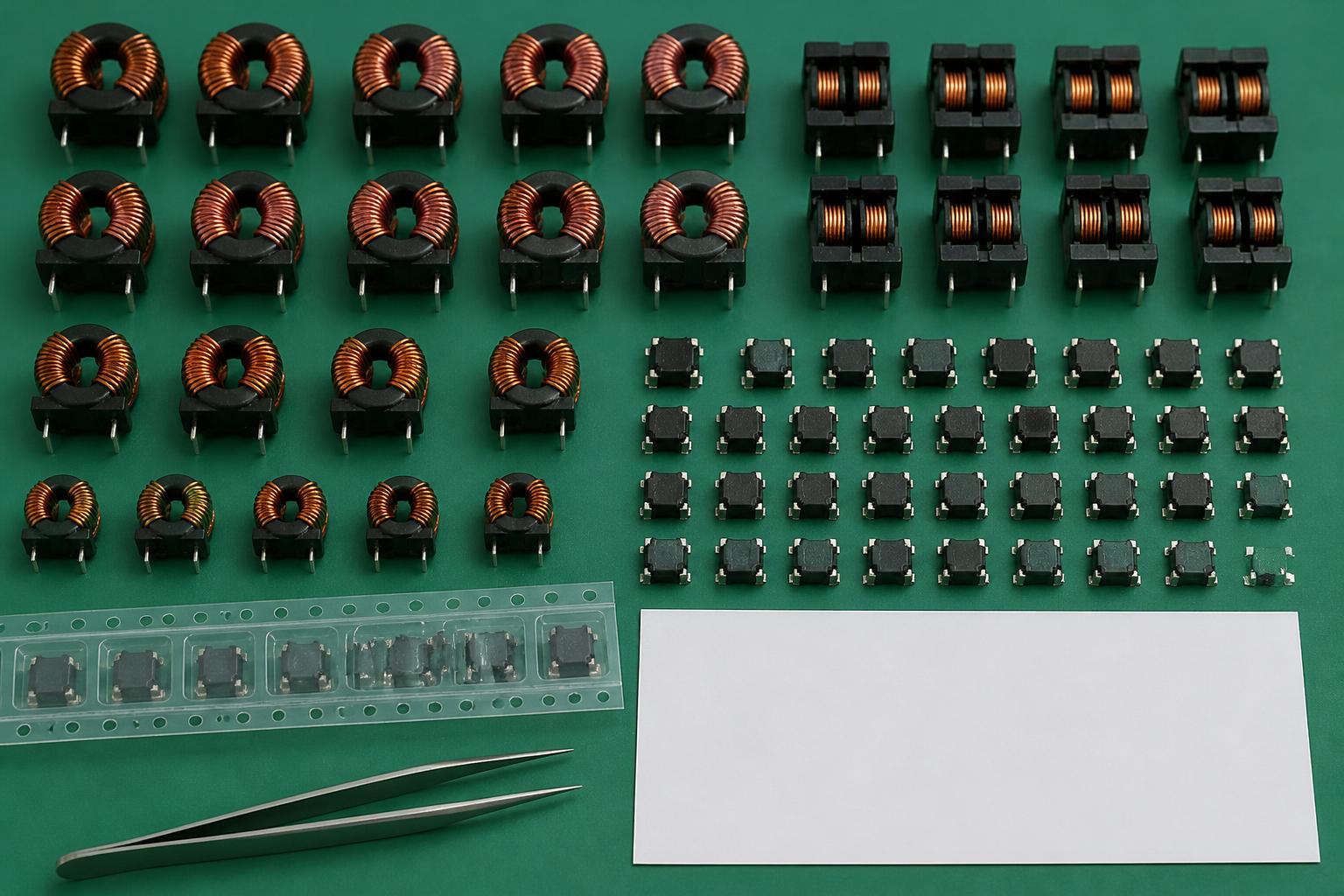
Use this checklist when factory stock contains labelled reels, through-hole chokes, opened packs or loose parts that may be mixed with power inductors, ferrite-bead arrays or small transformers. A common-mode choke has two or more coupled windings on a shared core. Its intended circuit role matters: a signal-line part and a power-input part should not be treated as interchangeable because a single printed value looks similar.
This is an inventory-recording method. It does not establish whether an unverified part is suitable for a new circuit.
Stage 1: separate the component type and application
Make separate rows for signal-line, DC power-input, AC mains-input and three-phase parts where those uses are known. Record package form, dimensions, number of lines and terminals, and visible winding arrangement. A typical two-line choke has two windings and at least four terminals; a single-winding power inductor commonly has two. A multimeter can help map which terminals belong to one winding, but paired continuity alone does not distinguish a choke from a ferrite-bead array. Use the full part number and the manufacturer's description to resolve that category.
Keep coupled inductors and small transformers in their own category when the datasheet describes an energy-transfer or transformer role. If the label is absent, write “type pending” and preserve a clear body and terminal photo rather than assigning a likely model.
Stage 2: record inductance and impedance as different fields
Power-line common-mode chokes are often specified by common-mode inductance in µH or mH, together with the measurement frequency and voltage. Signal-line chokes are often specified by common-mode impedance in ohms at a stated frequency, commonly 100 MHz. Do not convert one into the other as if they were the same stock-list value.
A three-digit segment or an R-marked segment in a part number is only a clue until that manufacturer's ordering guide identifies its position and unit. Transcribe the original code first. Put the confirmed inductance or impedance, its tolerance and test condition in a separate column, with “manufacturer specification” as the source. If an LCR reading is taken, note the connection and test frequency as a measurement comment; an incorrect connection can measure leakage inductance rather than the published common-mode value.
Stage 3: verify ratings, packaging and condition
For each complete part number, copy the manufacturer's rated current and its temperature-rise condition. Record DC resistance as the specified value for each winding, rather than treating an ordinary multimeter's low-resistance reading as the specification. For a power-line part, also record rated voltage and any winding-to-winding withstand value shown in the relevant specification. Keep leakage inductance separate when it is provided.
Record original reel, partial reel, tray, box, loose or removed stock separately. Recount an opened package rather than using the quantity printed for the original full pack. Keep differently labelled, differently wound or mixed parts on separate rows. Put cracked cores, damaged wire insulation, distorted bases and other visible condition issues in a separate group for checking.
An inventory row is most useful when it contains the full part number, application category, form and dimensions, line and terminal count, confirmed inductance or impedance with its test conditions, rated current, DC resistance, packaging state and photos of the label, body and terminals.
Frequently asked questions
Can four terminals prove that a loose part is a common-mode choke? No. Ferrite-bead arrays and other coupled parts can have similar terminal counts. Use the original label, complete part number and manufacturer specification.
Can a power-line inductance value be compared directly with a signal-line impedance value? No. They describe different electrical quantities under stated test conditions. Keep them in separate columns.
Can rated current or DC resistance be filled from a quick meter check? A continuity check may show whether a winding is open, but it does not establish the published current rating and is unreliable as a low-resistance specification. Copy those ratings from the matching datasheet, including the stated conditions.
Boundaries
Core colour, body appearance and terminal count can narrow a category but cannot confirm core material, full part number or electrical rating. A measured value depends on connection and test conditions and must not overwrite the manufacturer's stated value. This guide describes general practice; it contains no named customer case, completed transaction or service result.
Next step
Build one row per confirmed part number, application and packaging state. Attach the original label and body and terminal photos; mark unresolved categories and ratings pending. For a whole-lot inventory review, send the list through factory inventory handling or the recovery projects overview, with the uncertain rows clearly separated.
Need an initial inventory review?
Send Excel, carton-label photos and the warehouse city. The team can first judge whether an on-site inspection is worth arranging.