
Shenzhen Yueding Hengye Technology Co., Ltd. is based in Huaqiangbei, Shenzhen. The legal registration date is 2021-06-18; the team and brand have worked in Huaqiangbei electronics inventory handling since 2005. Phone / WeChat: 15876164761.
Direct answer: Copy the complete part number, including its suffix, from the bag, tube or reel label and check the matching manufacturer drawing. Record pitch, rows and contacts per row, mounting form, plastic-body height, exposed and solder-tail lengths, plating as stated in the specification, and packaging state in separate fields. Measure pitch across several pin intervals instead of guessing from one gap. Keep unlabelled, cut and used strips separate. Their colour does not establish plating or rating.
When this checklist applies
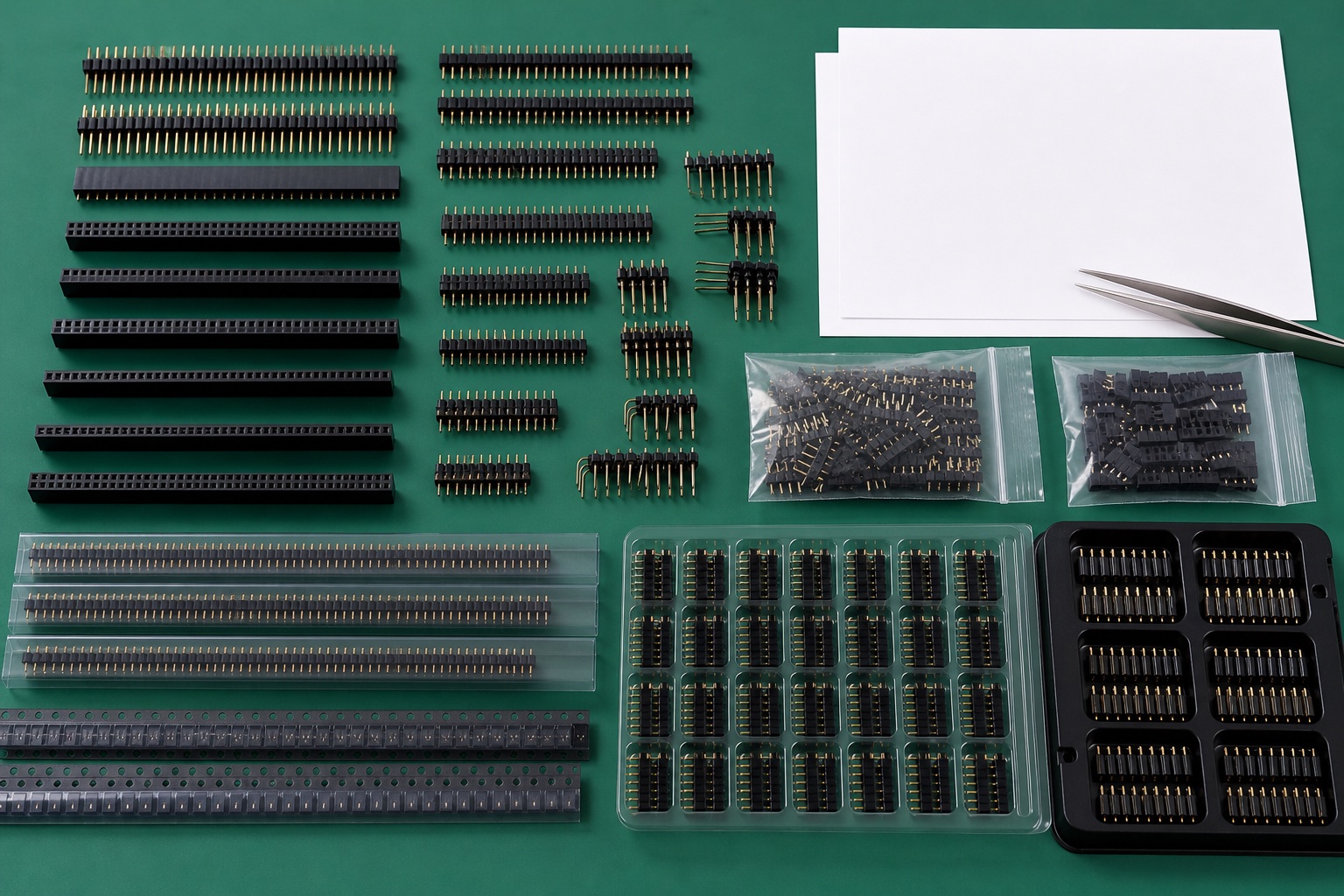
This checklist is for factory inventory containing unshrouded pin headers and mating socket strips, including straight, right-angle and surface-mount forms. Keep round-pin versions on their own rows. A shrouded box header, a wire-to-board housing, a spring contact, a jumper cap and an IC socket are different categories even when they sit near the same stock.
The list supports identification and an initial stock review. It does not prove that an unlabelled strip is interchangeable with a connector already specified for a board.
Stage 1: measure pitch and write the row layout
Measure from the centre of the first pin to the centre of a pin several intervals away, then divide by the number of intervals. Measuring the same edge of both pins is another way to capture the same span. For a two-row part, record row-to-row pitch separately. Note whether the contacts are square or round; do not merge round-pin and ordinary socket versions by appearance.
Retain the label's original metric or imperial pitch notation. If you add a millimetre conversion, mark it as converted: 1 inch is 25.4 mm and 1 mil is 0.0254 mm. Similar-looking pitches written under different standards should remain separate until the complete part number and drawing confirm a match.
Write the layout as rows × contacts per row, with the total contact count in another field. Mark any missing positions. If a header strip has been snapped into shorter pieces, count the actual segments or total pins rather than multiplying by the original full-strip count. Mark a cut socket strip separately.
Stage 2: distinguish mounting form, height and length
Separate straight through-hole, right-angle through-hole, vertical surface-mount and horizontal surface-mount parts. Record pin direction and locating posts where present. For surface-mount stock, note whether a pickup cap or film is still attached. Parts with different mounting forms are different inventory rows even if pitch and contact count match.
Use the manufacturer's dimension drawing to name the measurement points. For a pin header, distinguish plastic-body height, mating-side pin length and solder-tail length. For a socket strip, record body height, solder-tail length and the specified insertion depth when available. Keep variants with different body height or pin length apart; a common pitch does not settle board spacing or fit.
Stage 3: verify plating and packaging without guessing
The contact area and solder tail can have different plating. Copy their finishes, any underplating and thickness from the matching specification, retaining its original units. A gold-coloured or dull pin is only a sorting observation; it does not establish metal composition, coating thickness or electrical rating. Record colour and visible oxidation in an appearance field, and leave plating pending when no reliable part number or specification is available.
The body may show a mould mark or first-pin indicator without showing an orderable model. Photograph the original label, front, side and underside with a scale. For unlabelled strips, leave the model and plating unresolved and record only measured dimensions and visible condition.
List tubes, bags, reels, trays and loose segments with explicit units: tubes, strips, segments or pins. Recount opened packs. Keep bent or cut tails, removed parts and mixed bags away from intact new stock. A quantity such as “20” is ambiguous until the unit and contacts per strip are stated.
Frequently asked questions
Can two strips with almost the same measured pitch share one row? Keep them separate until the labelled part numbers and drawings confirm the same pitch and other recorded dimensions. Repeat the measurement across more pin intervals if the result is uncertain.
Does a gold-looking contact prove gold plating? No. Appearance can help sort a batch, but finish and thickness come from the matching manufacturer specification.
How should a bag of snapped header strips be counted? Group by actual segment length, state the number of segments or total pins, and keep them separate from full strips.
Boundaries
Measurements and photos can narrow an unlabelled part's category, but they do not supply a complete manufacturer part number, plating specification, current rating or temperature rating. Pitch, row layout, mounting form, body height, pin length or stock condition differences call for separate rows. This is general practice with no named customer case or reported transaction result.
Next step
Create a row for each confirmed part number and stock condition. Attach the original label and dimension photos, preserve the specification's plating wording, and mark unsupported values pending. For a lot review, send the sheet through connector inventory recovery or factory inventory handling.
Need an initial inventory review?
Send Excel, carton-label photos and the warehouse city. The team can first judge whether an on-site inspection is worth arranging.