
Shenzhen Yueding Hengye Technology Co., Ltd. is based in Huaqiangbei, Shenzhen. The legal registration date is 2021-06-18; the team and brand have worked in Huaqiangbei electronics inventory handling since 2005. Phone / WeChat: 15876164761.
Direct answer: Start with the complete part number, including its suffix, on the reel or box label. Check that number against the manufacturer's datasheet, then use the device's top marking to cross-check it. Put the marking in its own field, not in the part-number field. Record N or P channel (or a dual-device configuration), package and pinout, VDS, ID and RDS(on) with their stated test conditions, and the actual packaging state. If the label is missing, a marking lookup gives candidates only; leave the model and unsupported ratings pending.
When this checklist applies
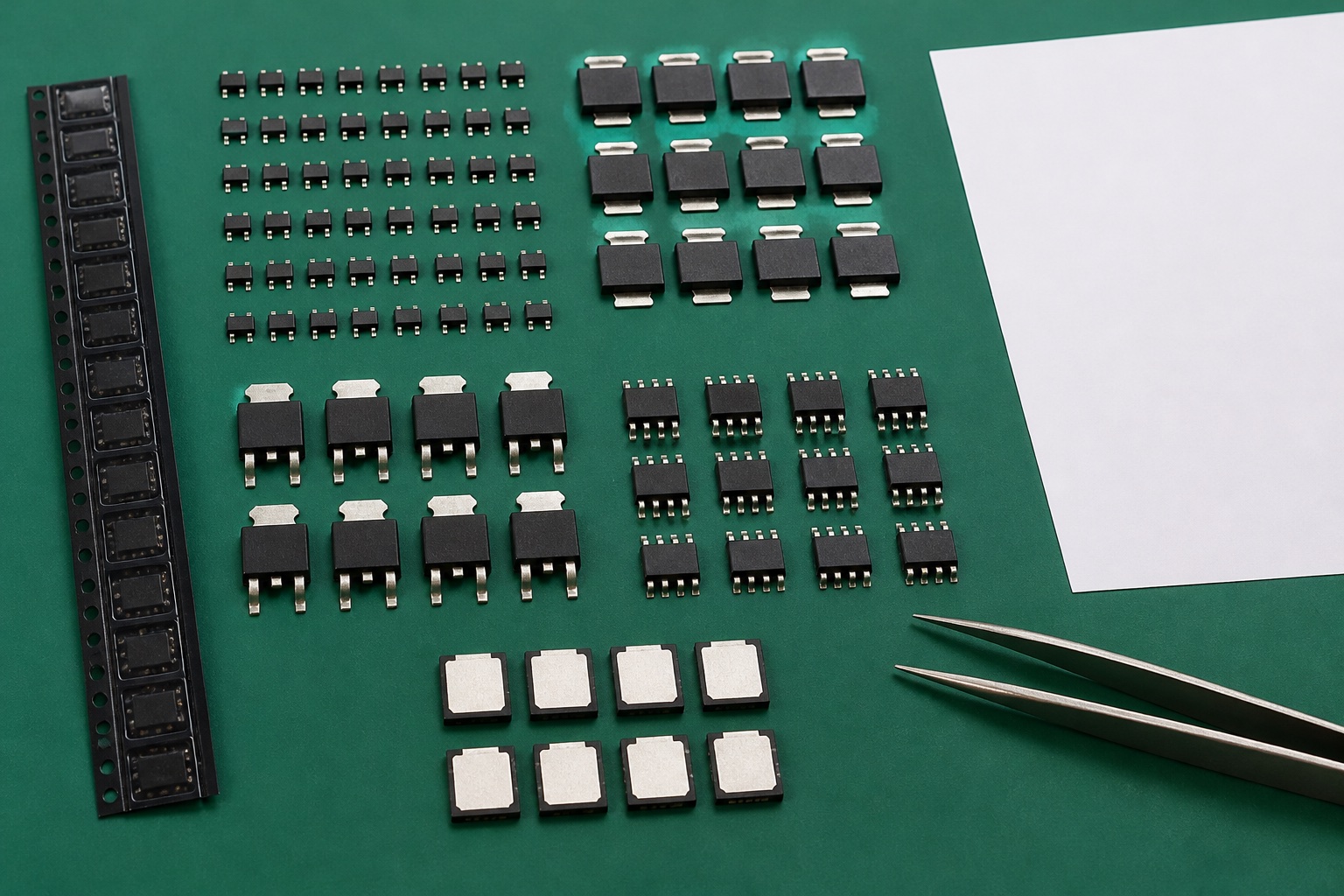
Use this method for surface-mount MOSFETs in small packages such as SOT-23 or SOT-323, power packages such as SOT-223 and TO-252, and multi-pin SOP or DFN packages. A similar shell may also hold a transistor, diode, thyristor or regulator. This is an inventory-identification checklist, not an electrical acceptance test or a replacement approval.
For a labelled reel, use the original part number and manufacturer's marking, pin-configuration and electrical-characteristics sections. For loose parts, list the package, readable marking and any visible brand mark, but keep every unverified candidate separate from identified stock.
Stage 1: separate the part number from the top marking
Copy every line on the reel or carton label, including the full suffix. A small device may show only a two- or three-character code, sometimes with a dot or line. Larger packages may carry a shortened model and date or lot text. The code is an index into a manufacturer's marking information; it is not a universal abbreviation of the orderable part number. The same code may identify different devices across makers, while a similar device can have different codes.
If there is no original label, measure the body and pin spacing to identify the package, search the code together with that package, and use a visible maker mark to narrow the candidates. Write each result as a candidate with its basis. A worn or unreadable marking should be recorded as such and kept on a separate row.
Stage 2: check channel, pinout and ratings with their conditions
The datasheet description and symbol identify N or P channel and show whether the package holds one or two MOSFETs. N- and P-channel devices can look identical. A diode-mode reading may help sort loose parts, but the body-diode direction alone cannot establish channel type when source and drain pins are unknown. Residual gate charge, an internal protection diode, a dual device or damage can also distort that reading. Do not promote a meter-based guess into a confirmed model.
Write the package name and the G, S and D pin numbers in different fields. Include the electrical connection of a thermal tab or exposed pad. A familiar SOT-23 pin arrangement is not a rule for every part number. For a dual device, record its N+N, P+P or N+P configuration instead of merging it with single devices.
Copy rated values from the matching datasheet together with their conditions. In particular, ID depends on the stated case or ambient temperature, and RDS(on) must be paired with its VGS and current condition. If the datasheet gives several RDS(on) values at different gate voltages, keep those conditions visible. Package size or one resistance number does not prove interchangeability.
Stage 3: record stock condition before grouping rows
Use separate rows when channel type, dual-device configuration, package, pinout, voltage or RDS(on) grade differs. Also separate original sealed reels, opened reels, cut tape, tubes, loose parts and removed parts. A reel label's nominal count does not settle the count of cut or partly used tape.
Photograph the complete reel or box label, a close view of the body marking, and the bag or moisture-indicator state when present. MOSFETs can suffer electrostatic damage that is invisible from the outside. Mark loose parts in ordinary bags as lacking antistatic packaging. If a moisture barrier has been opened and its opening time is unknown, record that uncertainty; handling or baking decisions depend on the applicable datasheet and moisture-sensitivity information.
| Stock-list field | What to enter |
|---|---|
| Complete part number | Original label text with suffix, or “pending” if absent |
| Top marking | Exact visible code, separately from the part number |
| Channel and configuration | N, P, N+N, P+P, N+P, or pending; state the evidence |
| Package and pinout | Package dimensions or name, G/S/D pin numbers, exposed-pad connection |
| Electrical ratings | VDS, ID and RDS(on) with temperature, VGS or other stated conditions |
| Lot and stock condition | Date code or lot, quantity and unit, sealed or opened packaging, cut tape or removed status |
Frequently asked questions
Can I identify a SOT-23 device from a short top code alone? No. Combine the code with package dimensions and any maker mark to find candidates, then seek the original label and matching datasheet. Keep uncertain devices apart from confirmed MOSFET stock.
Does one-way D–S conduction prove an N-channel MOSFET? No. Without a confirmed source and drain pinout, the body-diode direction does not identify N versus P. Meter readings are supporting observations only.
Can opened and sealed reels of the same model share one row? Keep them separate. Record whether a moisture barrier is open and whether its opening time is known; do not infer production readiness from appearance.
Boundaries
Top markings, a shared package or a diode-mode reading cannot confirm the full model, pinout, voltage rating or usable condition by themselves. The manufacturer datasheet and original label govern confirmed fields. This page gives general inventory practice; it reports no named customer transaction or tested outcome.
Next step
Make one row per confirmed part number and stock condition, attach label and marking photos, and mark uncertain candidates pending. For a whole-lot review, send the list and photos through factory inventory handling or browse the recovery projects. The Chinese source guide has the fuller package examples.
Need an initial inventory review?
Send Excel, carton-label photos and the warehouse city. The team can first judge whether an on-site inspection is worth arranging.