
Shenzhen Yueding Hengye Technology Co., Ltd. is based in Huaqiangbei, Shenzhen. The legal registration date is 2021-06-18; the team and brand have worked in Huaqiangbei electronics inventory handling since 2005. Phone / WeChat: 15876164761.
Direct answer: Start with the complete manufacturer part number on the original bag, tube or reel label. Give each tactile switch a row for body length and width, actuator height, operating force, travel, terminal style and packaging condition. Copy force, travel, contact rating and life-test conditions from the matching specification. Measure dimensions only as a cross-check. When a loose switch has no reliable label, leave force, life and full model pending; button colour and finger feel do not establish them.
When this checklist applies
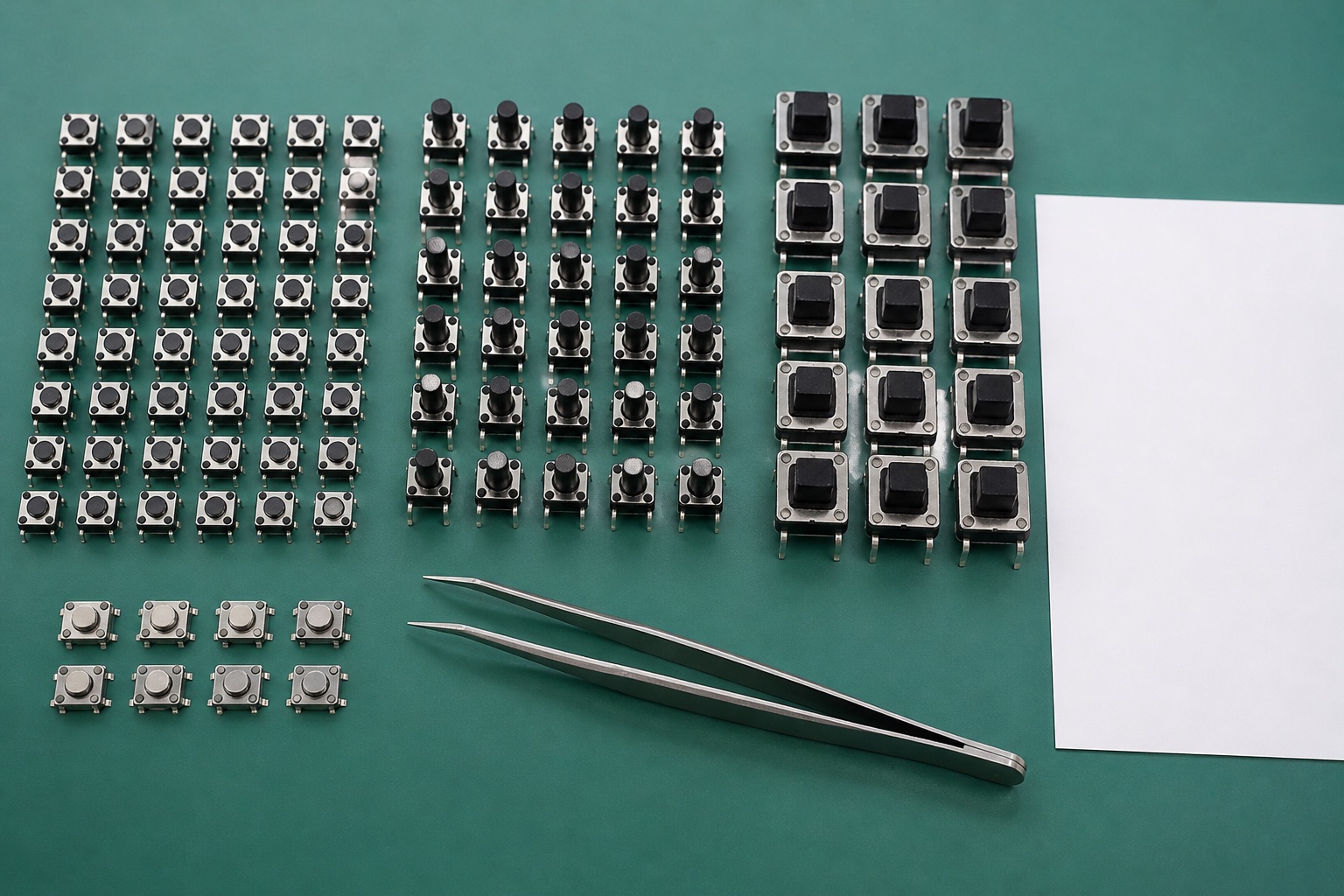
Use this checklist for mixed factory stock of momentary tactile switches, including through-hole, surface-mount and side-actuated parts. A tactile switch closes or changes its contact state while pressed and springs back when released. Keep latching push switches, microswitches, DIP switches and bare conductive-rubber keypads in separate categories. A normally closed tactile variant also needs its own row if the specification identifies one.
The checklist is for stock identification and preliminary review. It does not confirm that an unlabelled part fits a particular PCB or panel.
Stage 1: record body size and actuator height separately
Measure the body length and width at the outer edge of its cover or base, excluding protruding terminals. Record the total height from the mounting plane to the unpressed actuator top, using the maker's drawing to confirm where that plane is. Do not press the actuator with the caliper: that gives a depressed height. Note actuator shape, pin pitch and, for a side-actuated type, the direction and projection of the actuator.
The same body footprint can be offered with different actuator heights. Keep those variants apart even if their visible differences are small. Record an attached keycap separately when it changes the overall height.
Stage 2: copy force, travel and electrical ratings from the datasheet
Operating force may be listed in gf or N, usually with a tolerance. Travel is a separate distance. Preserve the original units and tolerance; if you convert units for comparison, mark the converted figure as such. A button colour may distinguish force options within a known maker's series, but colour conventions do not transfer across makers or series. Finger pressure is not a specification. A force-gauge reading, when needed, belongs in a measurement-note field rather than replacing the published force grade.
Copy contact rating, mechanical-life test conditions, contact resistance, insulation resistance, withstand voltage, temperature range and soldering or cleaning limits only when the matching specification provides them. Appearance cannot establish these ratings. A life number without its test conditions should not be used as a directly comparable stock-list value.
Stage 3: distinguish terminals and stock condition
Separate straight through-hole pins, right-angle pins, flat surface-mount terminals and side-actuated surface-mount forms. Note locating posts, case-ground terminals or lamp pins where present. On a common four-terminal version, two pins may be internally connected on each side and pressing connects the two groups. Use the maker's circuit diagram for the pin definition; a continuity check can support the grouping but should be recorded only as an observation.
Keep original reels, partial reels, tubes, loose bags, cut-pin parts and removed parts in different condition groups. Recount opened packs. Photograph the original label, actuator, body sides and terminals. A short body code may identify a family but usually is not the complete orderable number; match it with the label, dimensions and terminal drawing before assigning a model.
Frequently asked questions
Can identical-looking switches be combined into one row? Only after the complete part numbers and relevant specifications show the same height, force, travel, terminals and other recorded conditions. Otherwise keep separate rows.
Does a four-pin continuity reading prove the model? No. It can show contact grouping on a common design. Pin layout and rating still need the maker's drawing and specification.
Can button colour tell me the operating force? Only as a clue within a verified series. Without its label and ordering guide, mark the force pending.
Boundaries
Dimensions, colour, finger feel and continuity are sorting clues, not proof of operating force, life, contact rating or full part number. Cut or oxidized terminals and removed parts must not be represented as intact original stock. This guide describes general practice; it contains no named customer case or completed result.
Next step
Create one row per confirmed part number, actuator height, force grade, terminal form and packaging state. Attach label and terminal photos and flag unresolved values as pending. For a whole-lot initial review, send the list through factory inventory handling or the recovery projects overview.
Need an initial inventory review?
Send Excel, carton-label photos and the warehouse city. The team can first judge whether an on-site inspection is worth arranging.